On "Forage Fish", Pew's Peter Baker Misses the Mark
 "Forage fish" management in the California Current Ecosystem is the most precautionary in the world. Current ecosystem modeling efforts find that purse seine fisheries for coastal pelagic species harvest less than four percent (or two percent, depending on source) of the planktivorous forage pool."According to a paper by Kaplin et al 2012 in Fish and Fisheries. Cumulative impacts of fisheries in the California Current. This paper uses the Atlantis model to look at the effects of the major fisheries (by gear type) on other fisheries and species. The purse-seine fishery has the largest effect on other ecosystem components; almost all of the effects were positive! The purse-seine fishery (for coastal pelagic species) resulted in large increases in the Large planktivores, very little change in the small planktivores (they note that the fishery takes <4% of the small planktovore biomass), increases in salmon, deep-vertical migrators, misc pelagic sharks, large zooplankton, microzooplankton, and nearshore fish." - Dr. Richard Parrish, retired NMFS fishery biologist in Monterey who has more than 50 years’ knowledge of CPS and the California Current. --The paper A Case for Precautionary Management of Forage Fish, presented by Pew’s Peter Baker at the Managing Our Nation’s Fisheries Conference on May 8, is based on several assumptions about “forage fish” and predator species that are unproven. These unproven assumptions, as well as a lack of peer-review of the Lenfest Forage Fish Task Force that the paper extensively cites, should raise significant questions and engender in-depth review before its recommendations become standard practice in fisheries management.The paper’s recommendations are based around the assumption that “forage fish” is a legitimate and useful categorization of species to be used in fisheries management, and that the various “forage species” can be managed under the same broad guidelines. Specifically, the paper recommends implementing restrictions intended to leave forage species biomass at 75 percent of unfished levels. The paper argues that adopting this conservative management strategy will lead to an increase in the amount of forage available and will benefit predator species.However, these species have a variety of biological differences, and don’t have much in common outside of their common role in the marine food web. These significant differences--including fecundity, spawning periods, migration, predator-prey relationships, and habitat--are much more relevant variables for fisheries management than a shared trophic role.Read the full story here.
‘Mystery fish’ turns out to be 125-pound opah, a rare catch aboard Southern California half-day boat
 Anglers and crew aboard a Southern California half-day boat were astonished last week to see what the captain had reeled from the depths: a stunningly gorgeous moon-shaped denizen with a speckled body and bright-red fins.It was an opah, a species more commonly found in tropical and sub-tropical waters much farther offshore. Opah catches are rare off California, and extremely rare in coastal waters. To have landed one of these pelagic beauties from a half-day boat, within view of the shore, might be unprecedented.Opah2Capt. Jeff Patrick of the Western Pride hooked the 125-pound opah on a sardine at a depth of about 250 feet, while on a rockfish excursion out of Davey’s Locker Sportfishing in Newport Beach.The “mystery fish” was so feisty that he thought he had hooked a shark. The fight lasted 45 minutes and at one point the captain contemplated cutting the line because the rockfish had stopped biting and he wanted to relocate to a more productive area.Read the full story here.
MIKE CONROY: Squid Fishermen Fight Not ‘David vs. Goliath,’ More Like ‘Boy Who Cried Wolf’
Hearing claims of three squid brail (smaller boat) fishermen, one might think that the larger seine vessel squid fishermen are illegally catching all of the allowable quota.But that’s just not the case. In fact, not only is there an abundance of squid in California’s waters – more than enough to go around – most of the brail-boat fishing fleet have no problem with the current management structure.That’s because the squid resource is booming and most fishermen have been catching plenty of squid!Read the full story here.
Managing our Nation's Fisheries Conference looks to be a free for all in Washington DC next week
 SEAFOOD.COM NEWS by John Sackton - May 2, 2013The third Managing our Nations Fisheries Conference opens next week in Washington DC, and it promises to be a free for all with members of all the US regional management councils, NOAA, Commercial and recreational fishing associations, Pew, the Walton Family Foundation, Greenpeace and other NGOs, as well as dozens of Washington fisheries lobbyists and congressional staffers.The conference is looking at changes in Magnuson, including requirements for more flexibility; it is looking at ecosystem management, and habitat and forage fish protection.The conference is convened by the eight Regional Fishery Management Councils and hosted by the Pacific Fishery Management Council.According to the sponsors, this conference follows up on the highly successful Managing Our Nation's Fisheries conferences held in 2003 and 2005. Managing Our Nation's Fisheries 3 will focus on how concepts, policies, and practice of fishery sustainability can be advanced to a higher level.The discussion will address Magnuson-Stevens Act reauthorization issues, as well as adjustments to current management that do not require legislation to implement. The conference will provide a forum for information exchange and an opportunity to hear a wide range of perspectives on the sustainability of fish stocks and ecosystem functions, and the fishing communities that depend on them.Pew, a co-sponsor of the conference, is trying to get the drop on the agenda with the release of a position paper next monday making the argument that fisheries are still at risk, despite huge successes in eliminating overfishing in the U.S.Their position is that Many of our ocean ecosystems are severely compromised by decades of overfishing, habitat- damaging practices and indiscriminate fishing gear that captures and kills vast amounts of non-target ocean wildlife. In short, they are not recognizing the huge gains that have been made by US fisheries managers.Rather than focus on how to maximize stability and economic benefit for rebuilt fisheries, Pew and the NGOs are likely to advance an agenda calling for action in three areas:-More protection for essential fish habitat and to minimize by catch. This will likely take the form of increased efforts for gear restrictions on bottom trawling, as well as expansion of areas of marine reserves.-Plans to maintain resilient ocean ecosystems. Managing on an ecosystem basis is key to the future of successful fishery management, yet this approach can be abused if it does not modify existing species specific goals.The open question for ecosystem management is whether it means preserving the essential stability of an ecosystem while allowing for individual species variability, or whether it means extending the idea that all species should be at their maximum potential beyond commercial and recreational species to all animals and plants in the ecosystem.There is a real issue to be faced as to whether human modifications to an ecosystem are acceptable to marine environmental groups or not.-Finally, the NGOs are focusing on forage fish - species such as Menhaden, herring and sardines on the West Coast; whose stocks have largely been sustainably managed, but that now are being targeted for increased protections.
I will be at the conference, and mostly looking for the underlying assumptions to the arguments being made. The adoption of hard TACs and harvest control limits in the last reauthorization of Magnuson has proved to be a key factor in the success of US fisheries Management. Now the issues seem to turn more on a need for increased flexibility and a recognition that we have moved beyond overfishing, and now should concentrate on maximizing the benefits and maintaining healthy ecosystems.Those who advocate for increased restrictions - whether in habitat, elimination of fishing gear, or enhanced protection of forage fish, have to make the case as to why, when our fisheries have successfully recovered, we are still being asked to address these issues in a crisis mode. John Sackton, Editor And PublisherSeafood.com News 1-781-861-1441Email comments to jsackton@seafood.comCopyright 2013 Seafoodnews.comSource: Seafood.com News
NOAA issues status of stocks report; overfishing continues to decline in US
SEAFOOD.COM NEWS by John Sackton May 2, 2013NOAA released its 2012 status of the stocks report to Congress this morning, showing continued progress in eliminating overfishing and rebuilding stocks in the U.S.Overfishing declined 30% between 2011 and 2012. In 2011, 14% of the stocks where NOAA has data were being overfished. In 2012, that percentage dropped to 10%.Once overfishing is ended, a stock will typically recover to its MSY biomass. Stocks are classified as overfished when they are below the level needed to sustain harvests at the Maximum sustainable yield level. The number of stocks classified as overfished dropped from 21% to 19%, a decline of 10%.Acting Assistant Administrator for NOAA Fisheries Sam Rauch said "It was another record-setting year for our marine fisheries. Today, we are reporting that six more stocks were declared rebuilt in 2012, bringing the total number of stocks rebuilt since 2000 to 32. This year's rebuilt stocks include Southern Tanner crab, Acadian redfish, windowpane, yellowtail flounder, coho salmon, and pink shrimp. ""In addition, overfishing is at an all-time low with 10 additional stocks removed from the overfishing list since last year. The details behind these record-setting trends are included in NOAA Fisheries' new 2012 Report on the Status of U.S. Fisheries which is available online.He also noted "It is critical that we recognize the sacrifices that have been made and will be made to achieve these gains." So far, Congress has been very reluctant to acknowledge that the gains in fisheries sustainability have a price that has been borne almost exclusively by the seafood industry.
The supergule inspired by world's stickiest - which can hold up to 230 times its own bodyweight
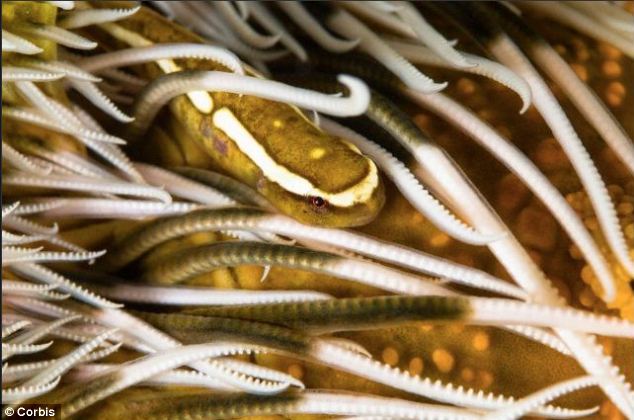 The world's stickiest fish, with an adhesive force up to 230 times its bodyweight, is set to inspire a new household superglue, according to researchers in North Carolina. The small Northern Clingfish is found in the Pacific, off the north west coast of the the US. It uses modified fins as a suction disk to hold onto the underside of rocks amid crashing waves.It fastens itself to rough edges by using pads of tiny hairs called microvilli which are similar to those on a gecko's feet.Researcher Dylan Wainwright and his colleagues from Duke University in Durham, North Carolina said the method is quick, reversible and readily works underwater.They said the fish's technology could be used for adhesive devices in medicine, industry and the home.The dusky coloured Northern Clingfish, also known as Gobiesox maeandricus, is a species of saltwater fish and measures about six-inches long.Shaped like tadpoles with a wide, flattened head they have no scales and are covered with a thick coating of slime that makes them very slippery.They are characterised by their large suction disc formed by the union of the pelvic fins and adjacent folds of flesh.The research team carried out experiments on 22 samples of Northern Clingfish, caught off the rocks of San Juan Island, Washington, and measured the fishes' adhesive force on eight surfaces.Seven of the surfaces had varying sizes of grit on them, and the eighth was made from glass, to see how the fish performed on an extremely smooth layer.Read the full story here.
Ocean temperatures highest in 150 years last year
The average temperature in that area hit a record high of 57.2 degrees last year.
 Sea-surface temperatures from Cape Hatteras, N.C., to the Gulf of Maine were the highest measured in 150 years in 2012, according to the National Oceanic and Atmospheric Administration (NOAA).The average temperature in that area hit a record high of 57.2 degrees last year. The previous record was set in 1951, according to NOAA.The average sea surface temperature has usually been below 54.3 degrees in the last 30 years, NOAA reports.The temperature is influencing fish and shellfish on the Northeast Shelf, according to NOAA.Four southern species – black sea bass, summer flounder, longfin squid and butterfish – have moved to the northeast, according to NOAA. American lobster has headed northeast but at a slower pace. Atlantic cod and haddock have moved in the opposite direction.Story from USA Today
Lower fishing limits rejected by judge
 A federal judge has rejected an environmental group's attempt to require the government to lower its catch limits on sardines, mackerel and other forage fish off the California coast.
The organization, Oceana, claimed that the plan approved by the National Marine Fisheries Service in 2010 was based on flawed data and allowed fishing at levels that would deplete offshore populations of several species. Those fish are part of the food chain for other fish, seabirds and whales.But U.S. District Judge Edward Chen of San Francisco said Friday that the federal agency had simply reaffirmed, or in some cases tightened, the harvesting limits it had set for the same forage species in 2000.Chen ordered the fisheries service to reconsider its catch levels for one species, the northern anchovy, saying the agency had reopened that subject in 2010 but failed to determine the limits needed to protect the fish. That decision is required, he said, by a 1976 conservation law designed to prevent overfishing.But Chen said it was too late to challenge the rules the agency had established in 2000 - and reaffirmed in 2010 - for the Pacific sardine, the Pacific mackerel, the jack mackerel and the market squid. Oceana also challenged the fisheries service's conclusion that its 2010 plan would cause no ecological harm and that a full environmental study was therefore not required. But the judge said the 2010 plan "by its very terms has no negative impact."Read the full San Francisco Chronicle article here.