Seafood and restaurant industries dodge a bullet as Gov. Brown vetoes California sfd labeling law
California Gov. Jerry Brown has vetoed Senate Bill 1138, the fish and shellfish labeling law, that would have created chaos for seafood consumers.The bill was pushed through the legislature by Oceana, who claimed that it would help combat seafood fraud. But the remedy - using the FDA common name for each species, rather than the standard market name is is now required, would have created chaos.The bill would have required that seafood producers, seafood processors, retailers, and restaurants label their packaging and menus with the “common” name of the seafood item, as opposed to the market name developed by the Food and Drug Administration.There are over 1850 common names for fish and shellfish sold in California. The FDA allows most similar species to be grouped under the same market name, for example "shrimp."In discussing why this bill was so bad, Mary Smith at Santa Monica Seafood said "A waitress would need to inform a customer ordering shrimp whether the shrimp was “Kadal Shrimp” or “Marsh Grass Shrimp” or “Jinga Shrimp” or one 30 possible Common Names for specific shrimp species."A worker at a food truck accepting an order for a mahi fish taco would need to inform the customer “at the time the customer orders” that she will be served dolphinfish.""Hotel restaurant staff would need to know and immediately inform a guest that his “Rockfish” was actually “Splitnose Rockfish” or “Swordspine Rockfish” or “Bronzespotted Rockfish” to comply with this law."It would be literally impossible for waitstaff to know the more than 1,850 Common Names of the fish served daily at California restaurants … and the law states a restaurant shall provide the Common Name when the customer orders the fish.Under the guise of protecting consumers, the real impact of this bill would be to reduce seafood consumption.NFI strongly supported this veto and was pleased to be able to work with the California Fish & Seafood Institute to explain the legislation’s flaws to the Governor and his staff. Though mislabeling and fraud are legitimate and serious issues, the California legislation would have done nothing to address them, and would have burdened NFI member companies with a complex and needless new mandate, while confusing consumers with additional labeling information of no value.In his veto Message, the Governor took this advice. He said "Much of what the bill seeks to accomplish is good. Requiring seafood producers and wholesalers to identify whether fish and shellfish are wild caught or farm raised, domestic or imported - these are reasonable and helpful facts for purchasers to know.""Requiring more precise, species-specific labeling of seafood. however, is not as easily achieved.""The U.S. Food and Drug Administration publishes both market names and common names under which fish and shellfish may be sold. The bill's requirement to use the FDA published common name in all fish and shellfish labels, unless the state promulgates a different common name, would create uncertainties and complexities that may not be easily resolved."The veto is a small success for the states restaurant and seafood industry. But it is unfortunate that so much time has to be spent lobbying and reacting to those who keep seeking to limit seafood consumption, under the guise of 'helping' the American consumers fight fraud.

John Sackton, Editor And PublisherSeafoodNews.com 1-781-861-1441Copyright © 2014 Seafoodnews.comStory Posted: 10/1/2014
El Niño forecast is up in the air for Southern California

With the summer winding down, weather officials say the winter forecast is wide open.While a mild-to-moderate El Niño weather pattern is widely expected to develop in the fall, forecast models have "projected many different outcomes," said Eric Boldt, a meteorologist with the National Weather Service."The odds of drier than normal winter are just as high as a wetter than normal winter," he said in a video released Tuesday.Last month, climatologists downgraded the chance of El Niño forming this fall from 80% to 65%. But the latest three-month outlook for January to March shows a potential for above-normal precipitation in Southwest California, Boldt said.Forecasters are in El Niño watch mode, noting that sea temperatures along the equatorial Pacific have warmed, a possible signal that the storm-producing weather system is strengthening, Boldt said.In the last four weeks, sea surface temperatures were also above average along the eastern equatorial Pacific Ocean.El Niño winters in Southwest California have been historically wet, which would be a welcome reprieve for a region parched by a prolonged drought.Nearly 60% of the state is experiencing "exceptional" drought conditions, the harshest on a five-level scale as measured by U.S. Drought Monitor.For breaking news in Los Angeles and throughout California, follow @VeronicaRochaLA. She can be reached at veronica.rocha@latimes.com.Copyright © 2014, Los Angeles Times
View the original post here.
In massive nod to success of West Coast industry and managers, Monterey Aquarium upgrades 21 species
Copyright © 2014 Seafoodnews.com - Posted with permission from SEAFOODNEWS.COMSEAFOODNEWS.COM by John Sackton - Sept 3, 2014 In a massive nod to the success of US fishery managers, Monterey Bay Aquarium has upgraded its consumer guide on 21 west coast groundfish and rockfish species.
John Sackton, Editor And PublisherSeafoodNews.com 1-781-861-1441Email comments to jsackton@seafood.comCopyright © 2014 Seafoodnews.com
Monterey Wharf Walks: The Story of Squid
 Photo: Ashley Tedesco
Amble out on a story-packed stroll, one that considers the town's seafaring history.
SQUID IN THE SPOTLIGHT: It's sometimes difficult to narrow down what natural focus a town might have regarding the wildness that surrounds it. Sure, you could say that Klamath has strong ties to the redwoods and Big Sur to the condors, but most places snug against water or forest aren't all that associated with a specific bit of nature above all others in the region. Monterey, though, is associated with quite a few. Whales, yes, otters, yes, sardines, yes, the Monterey Cypress, yes. And squid? We'll wager that it is a rare day when the tentacled Pacific denizen tops otters and sardines in the list of "wildlife or natural wonders with Monterey cred," but squidly creatures do have old connections to the Bay-close city. Squid fishing was once a prominent industry, and Monterey Bay Fisheries Historian Tim Thomas is considering it in all of its historic and fascinating context during two upcoming Wharf Walks. They're set to set out on Saturday, Sept. 6 and Saturday, Oct. 4.BUT SQUID-ORIENTED FACTS... aren't the only thing on the table: calamari is, quite literally. Going with a "sea-to-table" theme, the Paluca Trattoria of Old Fisherman's Wharf will serve Wharf Walk participants a "complimentary calamari appetizer" after the stories wrap. How often do we head out into a history-rich to-do only to end it with an edible related to the stories at hand? Not often enough. A bonus treat: Possible napping seals or sea lions off Finger Pier. Calamari, squid history, and snoozing seals? Yeah, that's major Monterey cred right there.TO FOLLOW... all of the upcoming Wharf Walks, keep an eye on the Fisherman's Wharf page. And never fear, otters: You know you hold a special spot as the de facto fuzzy-faced ambassador of the M.B. area, but squids have played their role, too. Time to give them their briny due.
Copyright NBC Owned Television Stations
Read the original post here.
Monterey Bay - Squid Fishing - Thank You
Source: Monterey Harbor Update September 2014 -
The 2014 squid catch was an event of a life time! This years squid catch challenged the memory of local fisherman elders. They had a difficult time remembering a better year for the squid fishery going back to the 1960's. This year more than 1500 jobs were created for local companies during this season. This years catch and subsequent use of the pumping and landing facilities along with the associated track trailers challenged the users of the commercial wharf with parking, transportation, and access. The businesses, fisherman, boaters, and the public worked within a defined amount of space. The limitations of commercial wharf II was challenged to try and be all things to all users on wharf II this year. We wanted to let you know how much we appreciate the wharf II users being patient throughout this busy 2014 season.
Thank you.

Watch the video here: https://www.youtube.com/watch?feature=player_detailpage&v=O_F4KiMMpik
Pacific Ocean acidity dissolving shells of key species

Pacific Ocean acidity dissolving shells of key species: New research from NOAA sounding alarm bells about climate change
By Paul Rogers/San Jose Mercury News and Will Houston/The Times-Standard In a troubling new discovery, scientists studying ocean waters off California, Oregon and Washington have found the first evidence that increasing acidity in the ocean is dissolving the shells of a key species of tiny sea creature at the base of the food chain.The animals, a type of free-floating marine snail known as pteropods, are an important food source for salmon, herring, mackerel and other fish in the Pacific Ocean. Those fish are eaten not only by millions of people every year, but also by a wide variety of other sea creatures, from whales to dolphins to sea lions.Humboldt State University Oceanography Department Head Jeffrey Abell has conducted several studies on ocean acidification off the coast of Trinidad, most recently in 2010. Abell said that deeper ocean waters are usually more acidic due to bacteria digesting dead organism matter, called detritus, which floats to the ocean floors. This digestion releases carbon dioxide, which reacts with water and causes the ocean to increase in acidity. Abell said Humboldt County's shoreline is more prone to upwelling events in the late spring, which brings this deep, more acidic water to the surface."We don't see a consistent exposure to acidic waters," he said. "What we see is in the order of a few times to a dozen times a year during which the organisms, like pteropods, will be exposed to this corrosive water."Abell said Trinidad experienced about five of these events in 2007 -- lasting no longer than a few days -- but that number tripled to 15 episodes in 2010 that sometimes lasted over a week.If the trend continues, climate change scientists say, it will imperil the ocean environment."These are alarm bells," said Nina Bednarsek, a scientist with the National Oceanic and Atmospheric Administration in Seattle who helped lead the research. "This study makes us understand that we have made an impact on the ocean environment to the extent where we can actually see the shells dissolving right now."Scientists from NOAA and Oregon State University found that in waters near the West Coast shoreline, 53 percent of the tiny floating snails had shells that were severely dissolving -- double the estimate from 200 years ago.Until now, the impact on marine species from increasing ocean acidity because of climate change has been something that was tested in tanks in labs, but which was not considered an immediate concern like forest fires and droughts.The new study, published in the Proceedings of the Royal Society B, a scientific journal based in England, changes that."The pteropods are like the canary in the coal mine. If this is affecting them, it is affecting everything in the ocean at some level," said one of the nation's top marine biologists, Steve Palumbi, director of Stanford University's Hopkins Marine Station in Pacific Grove.The vast majority of the world's scientists -- including those at NOAA, NASA, the National Academy of Sciences and the World Meteorological Organization -- say the Earth's temperature is rising because of humans burning fossil fuels like oil and coal. That burning pumps carbon dioxide into the atmosphere and traps heat, similar to a greenhouse. Concentrations of carbon dioxide in the Earth's atmosphere have increased 25 percent since 1960 and are now at the highest levels in at least 800,000 years, according to measurements of air bubbles taken in ancient ice and other methods.Many of the impacts are already being felt. Since the 1880s, when modern temperature records were first taken, the 10 hottest years have all occurred since 1998. Polar ice has melted, forest fires are burning in the West with increasing frequency, and the ocean has risen 8 inches since 1900 at the Golden Gate Bridge.But what many people do not realize is that nearly a third of carbon dioxide emitted by humans is dissolved in the oceans. Some of that forms carbonic acid, which makes the ocean more corrosive.Over the past 200 years, the ocean's acidity has risen by roughly 30 percent. At the present rate, it is on track to rise by 70 percent by 2050 from preindustrial levels.More acidic water can harm oysters, clams, corals and other species that have calcium carbonate shells. Generally speaking, increasing the acidity by 50 percent from current levels is enough to kill some marine species, tests in labs have shown.Coastal Seafoods manager Greg Dale said Humboldt County's oyster industry has actually thrived over the last two years, but rising ocean acidity is "something we watch carefully.""If this keeps going, and it means shutting ocean productivity, that's when things get scary," Dale said. "The ocean changes every year, but if you change the (acidity), you will lose a great deal."Abell said the current ocean acidification levels are not enough to harm the shells of oysters or abalone, which are made of calcite, but are enough to dissolve the shells of pteropods, which are made of aragonite."Pteropods are the most sensitive of this process; they'll be kind of like an early warning system," Abell said. "The present school of thought is that 50 years from now is when we'll have to worry about the more sturdy shellfish, such as abalone."The new research on the marine snails does not show that increasingly acidic water is killing all of them, particularly older snails. But it is causing their shells to dissolve, which can make them more vulnerable to disease, slow their ability to evade predators and reduce their reproductive rates, the researchers said.Some of the corrosive water near the shore could be a result of other types of pollution, such as runoff from fertilizer and sewage, said Stanford's Palumbi, who was not involved in the NOAA research. But because the study found rates of the snails' shells dissolving in deep water, far from the shore, human-caused carbon dioxide is the prime suspect, he added.If people reduce emissions of fossil fuels, cutting carbon dioxide levels in the decades ahead, the damage to the oceans can still be limited, he said."But if we keep on the emissions profile we have now, by 2100 the oceans will be so harmed it's hard to imagine them coming back from that in anything less than thousands of years," Palumbi said."We are in a century of choice," he said. "We can choose the way we want it to go."
View original post here.
Lucrative crab industry in danger
Lucrative crab industry in danger | Sea Change: Ocean acidification | The Seattle Times
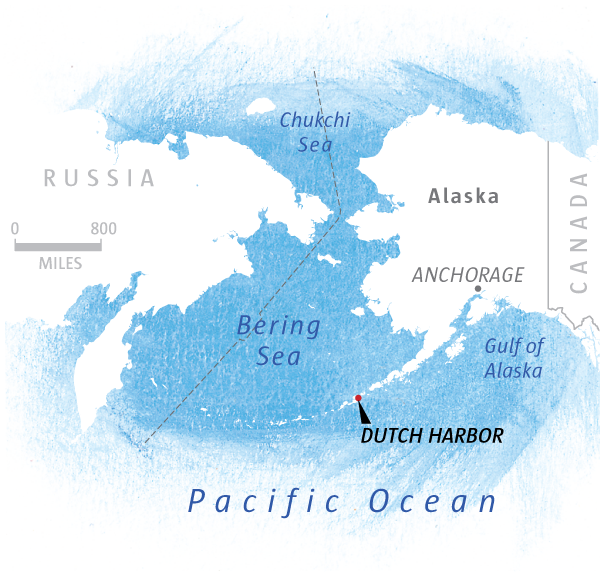
DUTCH HARBOR, Alaska — For decades, the crab piled up in fishing boats like gold coins hauled from a rich and fertile sea.But the very ocean that nursed these creatures may prove to be this industry’s undoing.New research earlier this year shows that Bristol Bay red king crab — the supersized monster that has come to symbolize the fortunes of Alaska’s crab fleet — could fall victim to the changing chemistry of the oceans.Barring a hasty reduction in carbon-dioxide emissions — or evidence that the creatures could acclimate to changing sea conditions — a team of scientists fears Alaska’s $100 million red king crab fishery could crash in decades to come.That grim possibility also raises alarm about the crab fleet’s other major moneymaker, snow crab.“With red king crab, it’s all doom and gloom,” said Robert Foy, who oversaw the crab research for the National Oceanic and Atmospheric Administration (NOAA) in Kodiak, Alaska. “With snow crab, there’s so little known we just can’t say. But we don’t see anything from our experience that’s good for any of these crab. Some is just not as bad as others.”
Potential impact on Alaska’s red king crab industry
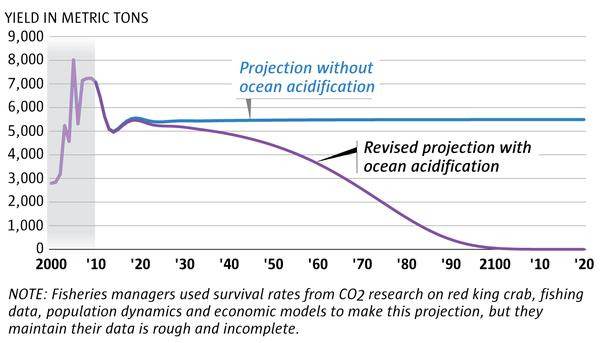
Source: NOAA, Alaska Fisheries Science Center
Mark Nowlin / The Seattle Times
Said Mark Gleason, director of the Seattle-based industry trade group Alaska Bering Sea Crabbers, “From my perspective, the chemistry is pretty clear-cut.”For decades, these storied crustaceans have drawn men and women from Seattle to the far reaches of the North Pacific. There, adventurers wrestled 800-pound steel cages amid raging seas and aprons of pack ice, hoping to strike it rich on a bounty of flaky meat and accordion legs.The emerging issues with Alaska’s crab underscore a predicament that stretches beyond the North Pacific. It gets to the difficulty of trying to comprehend the depth of fallout from ocean acidification.For reasons scientists don’t always understand, similar species, even those living side by side, often respond to changing water chemistry in remarkably different ways.“The real issue here is unpredictability,” said Richard Aronson, a Florida-based marine scientist who has tracked king crab in Antarctica. “There are all these unanticipated collateral impacts. The problem is, most of them are nasty surprises.”
‘We’re scared to death’
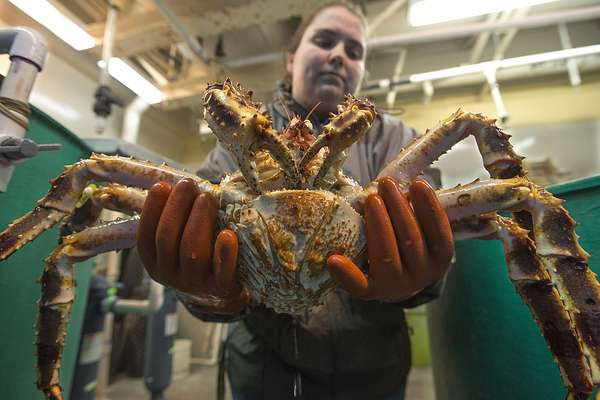
Certainly the threat to king crab was unexpected.As humans pump carbon dioxide into the atmosphere, a quarter of it gets absorbed by the seas. That lowers the water’s pH and alters the availability of carbonate ions, which crab rely on to build their exoskeletons.Many crab species appear hardy in the face of souring seas, or at least not so frail. Exceedingly corrosive waters actually pump up Maryland blue crab to three times their size and turn them into voracious predators. Sour waters kill Dungeness crab, but far less often than Alaska red king crab.When Foy and his colleagues exposed baby red king crab to CO2 levels expected by midcentury, the young died more than twice as often as crab raised in normal water. When researchers boosted CO2 to levels expected decades later, red king crab died in far larger numbers.“The overall survival at the larval and juvenile stage is extremely low,” Foy said. “It decreases to a point that is likely to affect the population of the crab.”Such a loss would exact quite a toll.“You say king crab, and most people associate that with Alaska,” said longtime crab-boat captain Kale Garcia, who lives outside Kent. “So, for it to go away, that’s a huge part of the identity for Alaska. I think it’d be devastating. I know it’d be devastating for me.”Red king crab is the showboat of the Northwest’s billion-dollar fishing industry. It is a television sensation and a marketer’s dream, its image emblazoned on bumper stickers, mugs, caps and T-shirts throughout the Pacific Northwest and Alaska.
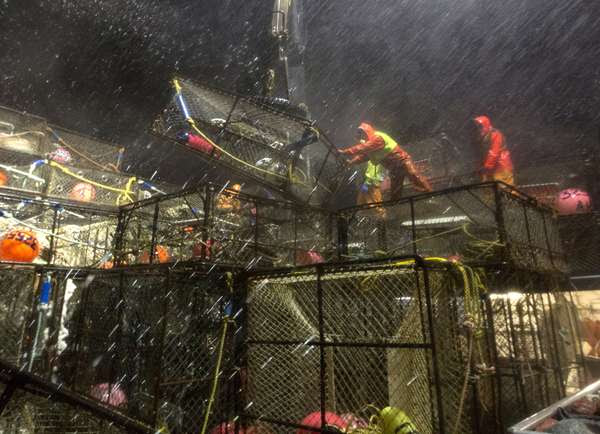
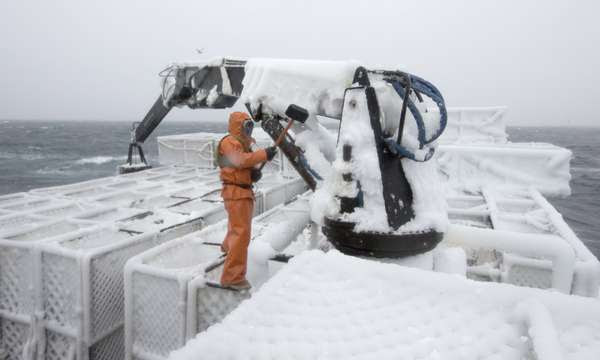
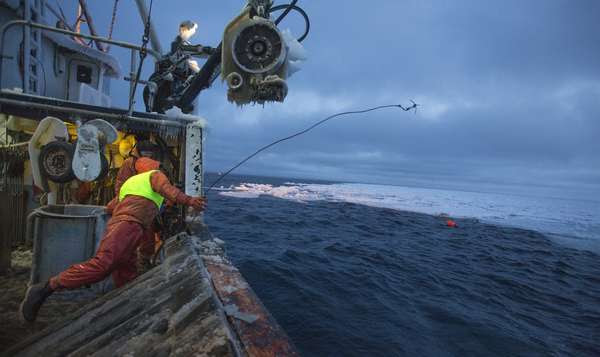
It is even a tourist attraction: Cruise-ship passengers stopping in Ketchikan pay $159 for a half-day ride to watch crews haul marine life aboard a 107-foot crab boat that appeared on Discovery Channel’s “Deadliest Catch.”Alaska’s commercial crabbers also catch small loads of golden king crab and Tanner crab, but the real cash comes from just two species — red king crab and snow crab. The 54 million pounds of snow crab caught in 2011 brought the fleet $115 million dockside. But a mere 14.8 million pounds of red king crab brought nearly as much — $92.5 million. And it can fetch $39.99 a pound at Pike Place Market.Crabbing attracts tough adrenaline junkies who disappear for weeks into the storm-buffeted frontier of the Bering Sea. They lounge in cramped quarters watching bad movies and wait for crab to fill their cages. Then workers scramble day or night on icy decks through stomach-churning swells, amped on coffee and nicotine.“A lot of people that are involved in the industry, it’s something they’ve been in forever,” Garcia said. “People like that don’t plan an exit strategy out of the fishery. There is no exit strategy. They’re like ‘This is what we do. We fish.’ ”NOAA researchers are using Bob Foy’s research to develop models and a timeline that charts the potential collapse of king crab. But things are changing quickly.“Bob reared those crabs under conditions that we thought were some time off in the future,” said Jeremy Mathis, a NOAA oceanographer who specializes in Alaska and the Arctic. “And what we actually found is that in certain times of the year, the conditions near the bottom in the Bering Sea were actually worse than the conditions that Bob was raising his crabs under.”There’s no evidence that souring seas have yet altered wild populations — the most corrosive seas now occur at times when red king crab aren’t as susceptible. But Alaska’s crab industry has followed the science closely.“All of us in the fishing industry are looking at each other and going ‘This sucks,’ ” said Ed Poulsen, former science adviser to the crab industry group. “I can tell you right now I’m doing all I can to get into other fisheries. I’m diversifying. With these changes in the environment, I think things are probably not going to get better.”Still, Jim Stone, of Lakewood, Pierce County, co-owner of the Bering Sea crab boat Arctic Hunter, is trying to remain optimistic.“We’re scared to death,” Stone said. “But we’ve heard a lot of horror stories before.”
Adaptation possible, but uncertain
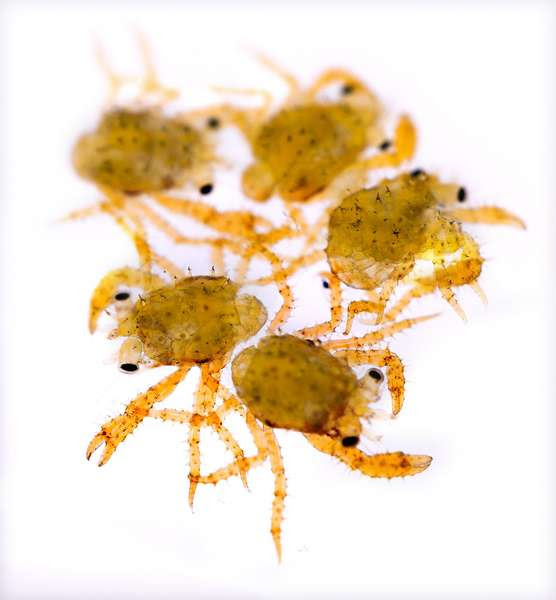
The research comes with plenty of caveats. No laboratory setting can ever properly approximate what happens in nature. Scientists are still conducting genetic tests to see if king crab might have the ability to adapt.“It’s not unreasonable to assume, for example, that they might move, that some form of rapid evolution will occur, that they may become somewhat more robust,” said Andre Punt, a University of Washington professor who worked on the research and assesses crab for fishing regulators.But the situation also might be worse than first thought. Souring seas could hit crab at several additional stages of development or attack their food.“They could be impacted in other parts of the water column,” Punt said. “The prey that they’re eating could be impacted.”Ocean acidification is also not the only marine-world change under way. Warming seas, also caused by carbon emissions, could compound crab’s troubles.“Anytime you’re working with an organism at the edge of its threshold and you add another stressor, that’s going to be an issue,” Foy said. “When you’re working in the subarctic environment like we are in the Bering Sea, these animals are always living at the edge of their tolerance in one season or another.”And while king crab’s future has everyone scrambling, the future for snow crab, which brings in more money, could be equally disconcerting.
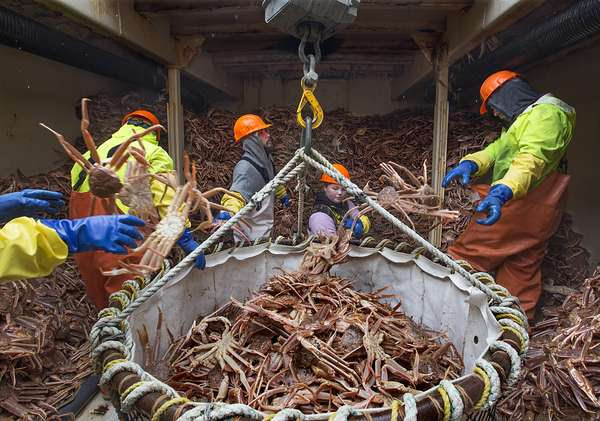
No two crab species react same way
No two Alaskan crab species have responded to CO2 exactly the same way. They seem to react differently depending on where they live at certain stages of their lives.Golden king crab, for example, live extremely deep, below 1,000 feet, where waters already are naturally rich in CO2. That appeared to make them highly tolerant of sea-chemistry changes.Meanwhile, baby Tanner crab exposed to high CO2 died at a higher rate than normal — but nowhere near as often as king crab. Foy suspects that’s because young Tanner crab live in water that already experiences vast swings in pH, depending on tides, time of day and photosynthesis.Tanner crab probably are used to more variations than king crab, which remain on the outer continental shelf.While snow crab are genetically similar to Tanner crab, their young spend more time at moderate depths.But with snow crab, scientists have struggled to perform extensive tests. The animals are just too hard to keep alive in the lab.It’s also hard to know how Foy’s results will translate to other species in other waters.A related king crab species has recently been seen by the millions in Antarctica, where it is devouring shellfish and starfish. Scientists are debating whether or not the crab is native.Will more acidic conditions kill these creatures or drive them out? Since they often occupy far deeper water, does that mean they instead might thrive?
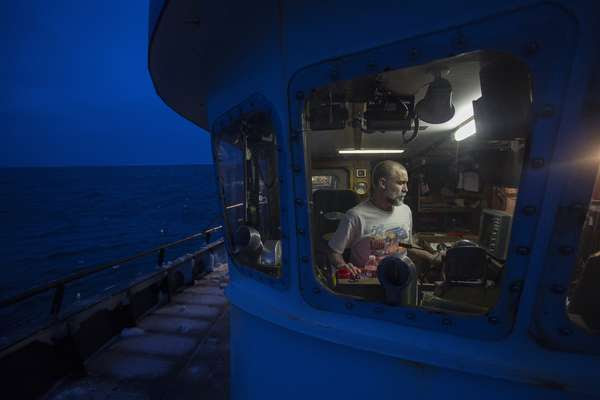
“There’s a lot of ifs, ifs, ifs,” said Aronson, who documented Antarctica’s crabs during a cruise in 2010. “I’ve found that the number of times the surprise with carbon-dioxide emissions has been undesirable far outweighs the times it’s been desirable.”The weird purgatory for these signature creatures unnerved Brett Robinson, who captains Stone’s Arctic Hunter.“It’s scary as hell, if something doesn’t get figured out,” Robinson said. “I don’t know.”“I guess you won’t have to fish for them” in the future, he added. “They’ll figure out how to grow these things in an aquarium or something.”
Hatchery may be part of future
Scientists in Seward, a thousand miles from the fishing grounds, are working toward just that.For years, a shellfish hatchery has been learning how to raise baby king crab from scratch. The program started as an experiment to see if baby crab could be transplanted near Kodiak Island, where massive crab populations crashed in the 1970s and 1980s. But the rising threat from acidification has insiders closely watching their work.Crab are most susceptible to corroding seas as babies, when a mere fraction of young survive even in perfect conditions. At the Alutiiq Pride Shellfish Hatchery, survival can be 500 times higher.Still, no one expects this operation could ever replace wild king crab. The orders of magnitude required to get enough crab to populate the Bering Sea would be ridiculous.But perfecting the science could provide options, such as the ability to repopulate a few previously devastated areas.“We’re hoping that it never gets to the point that they rely on the hatchery for that kind of work,” hatchery manager Jeff Hetrick said. “If we get to that point I think we’re in trouble. But it is a possibility.”The idea that crab might be partially grown in a lab instead of the ocean frustrated Mizrain Rodriguez, another Arctic Hunter crewman. But it also saddened him to think that humans could be doing such damage to the sea.“Every single animal on this planet lives in balance with its surroundings except us,” Rodriguez said. “We see it. We understand it. But we don’t want to do anything about it. It seems like we are on this destructive path.”
View the original post here.
Fishing Fleets Search for Squid Off Santa Barbara Shores
Read the original post here on noozhawk.com

A brightly lit commercial fishing vessel hunting for squid sits just offshore from Santa Barbara on a recent night. (Mike Eliason/Noozhawk photo)
Market squid are spawning in more places than normal, including in local watersBright lights seen off the shores of Santa Barbara signify the return of squid-fishing fleets locally, a common occurrence in recent years but still a bit unusual, experts say.Santa Barbara isn’t typically a popular squid-spawning locale. But cooler surface temperatures in nutrient-rich Pacific Ocean waters the past four years have caused smaller California market squid to spawn like crazy everywhere, according to Diane Pleschner-Steele, executive director of California Wetfish Producers Association.A market squid usually grows to eight inches long with its eight legs and two feeding tentacles— sometimes up to a foot — and lives about nine months, she said.The animals are one of the smallest of all 300-plus species of squid, and die after laying eggs in sandy, shallow water, which is where fishermen come in.Most squid are caught with help from light boats, which shine bright lights at the water to attract the animals to the surface. When they do, fishing boats catch the squid in nets and share about 20 percent of profits with their helpers, Pleschner-Steele said.She said squid-fishing season lasts nearly year-round, from April 1 through March 1, but closes whenever fishermen reach the statewide cap of 118,000 tons — a rarity.Boats usually follow squid from one spawning ground to the next, starting in Monterey and then heading south, sometimes netting near the northern Channel Islands and Ventura.Pleschner-Steele, who lives in Buellton, said La Niña effects have spurred squid to spawn near Santa Barbara and Carpinteria for unknown reasons, and fishermen hit the state’s tonnage quota in 2010.

“Squids are a fascinating animal,” Pleschner-Steele said. “We are learning more about them, and we’re learning how much we don’t know about them.”The California Wetfish Producers Association was founded in 2004 to promote sustainable fishing and to foster collaborative research with the California Department of Fish and Wildlife. The nonprofit also governs other so-called “wetfish,” such as sardines, mackerel, anchovies and coastal tuna.Although the squid fishery is the state’s largest in terms of volume and revenue, Pleschner-Steele said fishermen haven’t seen such solid production since the last La Niña effects in the late 1990s.The boom is likely nearing its end, however, she said.“We’ve just had four banner squid seasons,” she said. “The conditions were so ripe in so many places. These are small little animals but they are sure tasty.”
— Noozhawk staff writer Gina Potthoff can be reached at gpotthoff@noozhawk.com. Follow Noozhawk on Twitter: @noozhawk, @NoozhawkNews and @NoozhawkBiz. Connect with Noozhawk on Facebook.