Recipe: Grilled Sardines, Basque Port Style

There is nothing better than simply grilled sardines in season. They are a social food—you don’t eat one, you have an afternoon’s worth—and they arrive crusted in a bloom of evaporated seawater. Total Time: 20 minutes Serves: 4
- 1 cup kosher salt
- 10 cups room-temperature water
- 8 fresh Mediterranean, Greek or American sardines, rinsed, scaled, and optionally gutted
- ¼ cup extra-virgin olive oil
- Japanese or Maldon smoked sea salt, for finishing (optional)
- Grilled bread, for serving
1. Make a brine: Combine kosher salt and water in a large bowl or other vessel and stir to dissolve. Add sardines and let stand 15 minutes. Remove fish from brine, discard brine and pat fish on both sides with paper towels until thoroughly dry. Rub sardines with oil on both sides.2. Lightly oil an 8-inch wire-mesh strainer and place it directly on top of a burner on a gas stove. Turn burner on and allow screen to heat about 15 seconds. Place 4 oiled sardines on screen and then immediately lift screen 1-2 inches above flame to prevent burning sardines excessively. Return screen to burner and cook fish 1 minute on first side. Then, using tongs, carefully flip sardines and cook on the second side 30 seconds more. Expect some flames and crackling from the oily sardine juices that fall on the fire, and when flare-ups occur, pull screen away until flames die down, then move fish back to heat source. When fish are ready, transfer to a platter. Repeat until they are all cooked.3. Sprinkle sardines with smoked salt and serve immediately with grilled bread for soaking up juices.
Originally posted in The Wall Street Journal
Sardine stories
 Ray Hilborn is a professor in the School of Aquatic and Fishery Sciences at the University of Washington and a founding partner of cfooduw.org. Find him on twitter @hilbornr.
At the end of February, Dr. Geoff Shester, California campaign director for the nonprofit advocacy group Oceana, criticized the Pacific Fishery Management Council for the persistence of low numbers of California sardines. The lack of a population recovery may cause the commercial moratorium to last until 2017.The author explained this sardine population decline as being 93 percent less than it was in 2007. Shester does not believe this is because of environmental causes like climate change, El Niño or natural fluctuations in forage fish species, however. Instead he blames the management body.“They warned of a population collapse, and the fishery management body basically turned a blind eye and continued moving forward with business as usual.”Shester also cited recent sea lion deaths, specifically 3,000 that washed ashore in California in 2015.“When fishing pressure occurs during a decline, which is exactly what happened here,” says Shester, “it puts the stock at such dramatically low levels it impedes any recovery potentially for decades.” Shester’s comments are some of the most dishonest commentary I have seen in the fisheries world.He knows the NOAA scientists and Professor Tim Essington, in work funded by the Pew Foundation, have stated clearly that the decline in sardine abundance is due to natural causes. He also knows that sea lions are not dependent upon sardines; the die-off of sea lions is caused by the oceanographic conditions — not the result of fishing. In fact, reproductive failures of sea lions have occurred repeatedly in the past at times of high sardine abundance.If he has read Essington’s paper (“Fishing amplifies forage fish population collapses”) in Proceedings of the National Academy of Sciences, he would also know that there is no relationship between fishing and the duration of periods of low abundance of sardines and other forage fish.The harvest rule for sardines is highly precautionary, even when sardines are at high abundance, the harvest rate is low. Indeed the harvest control rule for sardines matches very well the recommended harvest rule for forage fish that emerged from the Lenfest report — that is a low target harvest rate at high abundance with the fishery closed when the stock reaches low abundance.Members of the Science and Statistical Committee of the Pacific Fishery Management Council have explained all this to Shester before. He simply continues to ignore science and pursue his own agenda.
Download the PDF of this article: http://www.nationalfisherman.com/images/pdfs/Article_PDFs/05_2016_NF_Sardine_Stories.pdf
NOAA issues La Niña watch as tropical Pacific temperatures tank
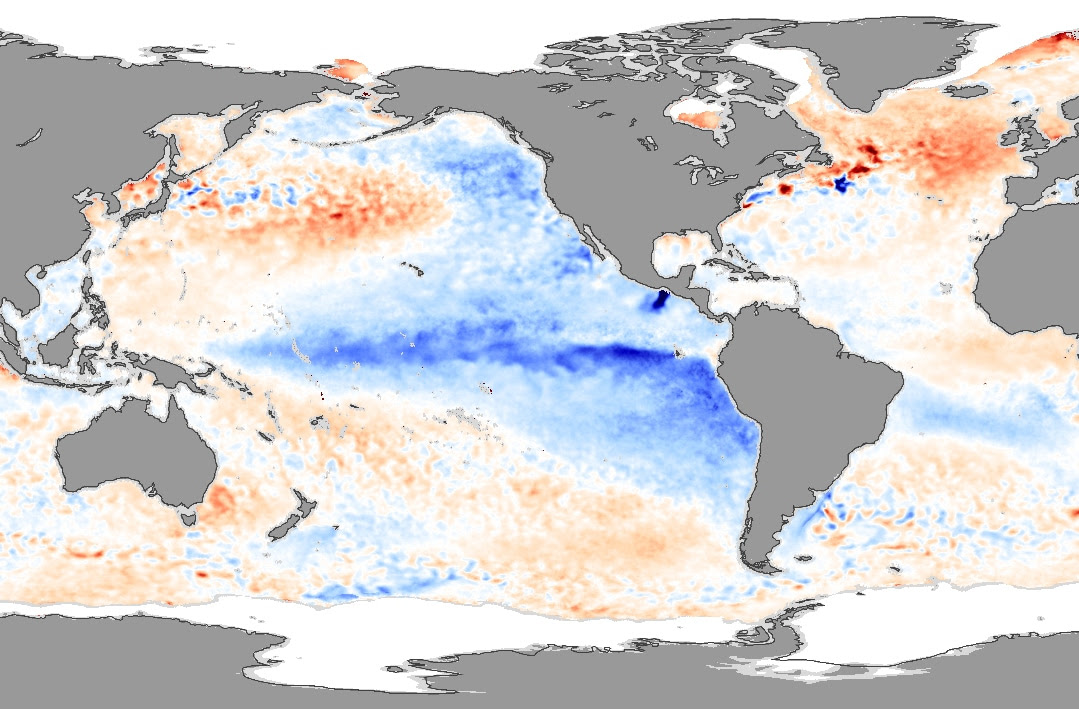
El Niño is quickly fading. Sea surface temperatures are coming down in the tropical Pacific, and winds in the region have weakened. History tells us, and forecast models predict, that La Niña conditions will be quick on its heels.Seeing the writing on the wall, NOAA issued a La Niña watch on Thursday. “Nearly all models predict further weakening of El Niño, with a transition to ENSO-neutral likely during late spring or early summer 2016,” NOAA’s Climate Prediction Center wrote. “Nearly all models predict further weakening of El Niño, with a transition to ENSO-neutral likely during late spring or early summer 2016. Then, the chance of La Niña increases during the late summer or early fall.”La Niña is El Niño’s cooler counterpart in the tropical Pacific Ocean. Whereas El Niño exhibits abnormally warm ocean temperatures and a strong atmospheric circulation across the equator, La Niña represents abnormally cold water. The cooler sea surface temperature pattern enhances the circulation in the tropics, called the Walker circulation.The Walker circulation tends to dominate the weather across the equatorial Pacific. Air flows west toward Indonesia, where water is typically the warmest, and rises. This creates lots of thunderstorms and rain. During El Niño, this circulation is disrupted. The warmest water sloshes to the eastern side of the Pacific near South America. Air ends up rising closer to South America, and it sinks over Indonesia.

La Niña is the exact opposite. It sends the circulation into overdrive.“During La Niña events … when waters in the western Pacific are even warmer than normal and waters in the eastern Pacific are even colder, it is like someone turned the normal Walker Circulation ‘up to 11,'” writes climate.gov’s Tom Di Liberto. “Warm, moist air rises even more over the Maritime Continent and South America leading to above-average rainfall. In the eastern Pacific, where colder than average waters exist, an enhanced downward branch of the Walker Circulation helps to further reduce the region’s already small rainfall totals.”
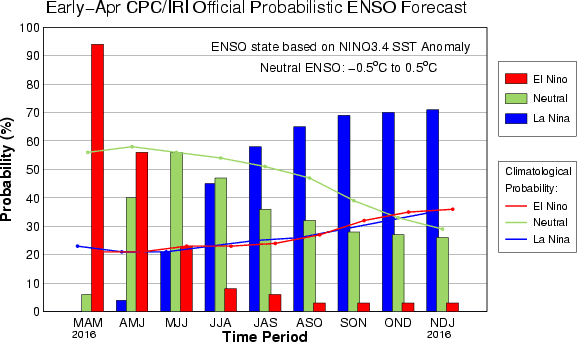
In its forecast, Columbia University’s International Research Institute for Climate and Society has increased the likelihood of La Niña to 65 percent by early fall, and a 70 percent chance by next winter. This is up from 50 percent last month.NOAA will “declare” a La Niña when temperatures across the eastern side of the Pacific have cooled to a temperature departure of 0.5 degrees Celsius below normal, and when the Walker circulation strengthens like we would expect it to during a true La Niña.
Read the original post: https://www.washingtonpost.com/
Professor Ray Hilborn wins 2016 International Fisheries Science Prize
April 11, 2016 — SAVING SEAFOOD — Professor Ray Hilborn, of the University of Washington’s School of Aquatic and Fishery Sciences, was recognized by the World Council of Fisheries Societies for his contributions to fishery management science.“Professor Hilborn has had an extremely impressive career of highly diversified research and publication in support of global fisheries science and conservation. Throughout his 40-year career, Ray has been a model of dynamic and innovative science, and in the application of this work to the ever-changing problems of fisheries management and conservation in both marine and freshwater ecosystems. Professor Hilborn’s Prize will be awarded at the World Fisheries Congress in Busan, South Korea in late May.”In recent years, Professor Hilborn has been one of the organizers of the Ram legacy Database at the University of Washington, which is the most complete global database on fish stocks, biomass surveys and catch history ever assembled. The resulting analysis and modeling from this database have not only united many fisheries scientists around the world who had been portrayed by the media as opposing each other in terms of fisheries conservation issues, but the database has also served to highlight a road map for fisheries conservation efforts over the next twenty years.As a result of these efforts, Hilborn has been instrumental in changing the perception that fish stocks were being fished to extinction and instead has shown that when fisheries management principles are properly applied, strong stock recoveries take place.Frustrated by the public misperception about the actual state of major fisheries, Hilborn and other colleagues have created cfood a website scientists use to communicate with journalists and the general public about fisheries science issues. The database, and website, have been particularly helpful in countering organizations who use distorted or outdated fisheries science to alarm regulators and the public.
This story originally appeared on Seafoodnews.com, a subscription site. It is reprinted with permission.
Federal regulators: Don’t even think about fishing for these forage species

Fishing boats line the dock along Timms Way in San Pedro. West Coast fishery managers banned the take of any forage fish (pelagic squid, herring), in a decision ratified by federal officials with a final rule issued this week, in state waters. The species aren't fished currently, and this is a move to protect them, in the event their numbers increase and become enough to sustain a productive fishery. (Chuck Bennett / Staff Photographer)

Read the original post: http://www.dailybreeze.com/
New NASA Study Shows Lessening El Nino Impacts This Spring
— Posted with permission of SEAFOODNEWS.COM. Please do not republish without their permission. —
Copyright © 2016 Seafoodnews.com


A new NASA study documents the current El Nino impact on the marine food chain, hoping to show where recovery may begin this spring. The preliminary conclusions are that a recovery from El Nino is underway and that in Chile and Peru, impacts were less devastating than the 1998 super El Nino.An El Nino, in which masses of warm tropical water slosh eastward to the coast of South America, has a huge impact on primary marine production, which NASA scientists are currently studying.El Nino's mass of warm water puts a lid on the normal currents of cold, deep water that typically rise to the surface along the equator and off the coast of Chile and Peru, said Stephanie Uz, ocean scientist at Goddard Space Flight Center in Greenbelt, Maryland. In a process called upwelling, those cold waters normally bring up the nutrients that feed the tiny organisms, which form the base of the food chain."An El Nino basically stops the normal upwelling," Uz said. "There's a lot of starvation that happens to the marine food web." These tiny plants, called phytoplankton, are fish food -- without them, fish populations drop, and the fishing industries that many coastal regions depend on can collapse.NASA satellite data and ocean color software allow scientists to calculate the amount of green chlorophyll -- and therefore the amount of phytoplankton present.The ocean color maps, based on a month's worth of satellite data, can show that El Nino impact on phytoplankton. In December 2015, at the peak of the current El Nino event, there was more blue -- and less green chlorophyll -- in the Pacific Ocean off of Peru and Chile, compared to the previous year. Uz and her colleagues are also watching as the El Nino weakens this spring, to see when and where the phytoplankton reappear as the upwelling cold water brings nutrients back to the region."They can pop back up pretty quickly, once they have a source of nutrients," Uz said.Researchers can also examine the differences in ocean color between two different El Nino events. During the large 1997-1998 El Nino event, the green chlorophyll virtually disappeared from the coast of Chile. This year's event, while it caused a drop in chlorophyll primarily along the equator, was much less severe for the coastal phytoplankton population. The reason -- the warmer-than-normal waters associated with the two El Nino events were centered in different geographical locations. In 1997-1998, the biggest ocean temperature abnormalities were in the eastern Pacific Ocean; this year the focus was in the central ocean. This difference impacts where the phytoplankton can feed on nutrients, and where the fish can feed on phytoplankton."When you have an East Pacific El Nino, like 1997-1998, it has a much bigger impact on the fisheries off of South America," Uz said. But Central Pacific El Nino events, like this year's, still have an impact on ocean ecosystems, just with a shift in location. Researchers are noting reduced food available along the food chain around the Galapagos Islands, for example. And there has been a drop in phytoplankton off the coast of South America, just not as dramatically as before.Scientists have more tools on hand to study this El Nino, and can study more elements of the event, Uz said. They're putting these tools to use to ask questions not just about ocean ecology, but about the carbon cycle as well."We know how important phytoplankton are for the marine food web, and we're trying to understand their role as a carbon pump," Uz said. The carbon pump refers to one of the ways the Earth system removes carbon dioxide from the atmosphere. When phytoplankton die, their carbon-based bodies sink to the ocean floor, where they can remain for millions of years. El Nino is a naturally occurring disruption to the typical ocean currents, she said -- so it's important to understand the phenomenon to better attribute what occurs naturally, and what occurs due to human-caused disruptions to the system.Other scientists at Goddard are investigating ways to forecast the ebbs and flows of nutrients using the center's supercomputers, incorporating data like winds, sea surface temperatures, air pressures and more."It's like weather forecasts, but for bionutrients and phytoplankton in the ocean," said Cecile Rousseaux, an ocean modeler with Goddard's Global Modeling and Assimilation Office. The forecasts could help fisheries managers estimate how good the catch could be in a particular year, she said, since fish populations depend on phytoplankton populations. The 1997-1998 El Nino led to a major collapse in the anchovy fishery off of Chile, which caused economic hardships for fishermen along the coast.So far, Rousseaux said, the phytoplankton forecast models haven't shown any collapses for the 2015-2016 El Nino, possibly because the warm water isn't reaching as far east in the Pacific this time around. The forecast of phytoplankton populations effort is a relatively new effort, she said, so it's too soon to make definite forecasts. But the data so far, from the modeling group and others, show conditions returning to a more normal state this spring.The next step for the model, she said, is to try to determine which individual species of phytoplankton will bloom where, based on nutrient amounts, temperatures and other factors -- using satellites and other tools to determine which kind of microscopic plant is where."We rely on satellite data, but this will go one step further and give us even more information," Rousseaux said.
Subscribe to SeafoodNews.com 1-781-861-1441 | Copyright © 2016 Seafoodnews.com
Research Shows Global Warm Water "Blobs" Have Grown in Intensity Over Last Forty Years
— Posted with permission of SEAFOODNEWS.COM. Please do not republish without their permission. —
Copyright © 2016 Seafoodnews.com
 In late 2013, a portion of the North Pacific Ocean off the coast of Washington, British Columbia, and Alaska became unusually warm. Parts of it five to six degrees Fahrenheit warmer than normal.This continent-sized patch quickly became known as "The Blob." Its ability to warm the air above is blamed for two record fire seasons in Washington state in 2014 and 2015, a drought, and record low snowpack in the winter of 2014/2015.Nick Bond, Washington State's climatologist, says while the blob has pretty much dissipated, we are still feeling some of the hangover effects, as the water along the West Coast is still one to two degrees above normal.Turns out “The Blob” isn't that rare. And unlike another ocean phenomenon known as El Nino, it's not just found in the Pacific Ocean.In a new research paper published in the journal Geophysical Research Letters, University of Washington oceanographer and doctoral student Hillary Scannell looks back through 65 years of warming events in both the North Atlantic as well as the North Pacific oceans."They're becoming more extreme,” said Scannell from her campus office.Scannell is the lead author of "Frequency of marine heatwaves in the North Atlantic and North Pacific since 1950.” At the University of Maine, she studied a 2012 blob or heatwave that, among other things, affected the lobster fishery.The research finds that the number of longer term, deeper events started in the 1970s. Before that, “they weren't occurring at such a high-temperature average, so the range of variability was much smaller and lower than it is now,” said Scannell.
Copyright © 2016 Seafoodnews.com Subscribe to: Seafoodnews.com
North Coast crab boats finally head out to sea

BODEGA BAY — Long-idled fishermen settled Tuesday on an opening price for Dungeness crab, transforming Bodega Harbor into a beehive of activity as they streamed out to open waters to begin the commercial crabbing season at last.Radiating relief and even cheer as they stocked up for the sleepless days and nights ahead, captains and deckhands wasted no time leaving the docks once stakeholders at the state’s major ports reached agreement on a price.Crab should hit local markets by the weekend, lured by thousands of traps baited with chunks of squid and mackerel cut up while still frozen on the docks Tuesday.“We’re just happy to go to work,” said Mark Gentry, a 30-year veteran of the fishery, who had only to finish pumping fuel into the tank of his boat, Rampage, before he and his crew could depart Spud Point Marina on Tuesday afternoon.“Ready to go play,” said Sean Amoroso, captain of the Donna Mia. “Ready to play and get a paycheck.”The state’s Dungeness crab catch is typically valued above $60 million, peaking in 2011-12 at $95.5 million. Crabbers make the vast majority of their income in the season’s first few weeks. The opening price agreed to Tuesday is $2.90 a pound, just under the $3 at which they started the 2014-15 season.Many of the fisherman and, especially, their crews have been through desperate times in recent months as an unprecedented delay in the opening of the commercial season dragged on week after week, caused by an outbreak of harmful algae and a related neurotoxin called domoic acid.The season normally opens Nov. 15 south of the Mendocino County line and Dec. 1 in waters north of there. The closure meant crabbers missed out on the lucrative Thanksgiving, Christmas and New Year’s markets, with months still to go before the fishery would reopen — though they didn’t know it at the time.When state regulators earlier this month finally notified commercial crabbers they could begin harvesting the succulent crustaceans last Saturday, the delay had cost them 4 1/2 months.They waited at dock several days more while test crabs were fetched, cooked and measured to ensure they met the threshold of 25 percent meat. Crabs from different ports came in above the mark, North Coast Fisheries President Mike Lucas said Monday.Fish processors and fishermen in Bodega Bay, Half Moon Bay and San Francisco all agreed by late Tuesday morning to start the season at $2.90 a pound, inciting a mad dash to acquire bait, fuel, groceries and other necessities no one wanted to buy until they could be sure of covering their costs.By afternoon, dozens of boats had motored from the harbor out to open ocean as those remaining hustled to join them.“This is what we love to do,” Annabelle deck hand Merlin Kolb, 45, said as he cut bait and loaded it into plastic containers.His crew mate, Diego Quiroz, grinned. “We’re going to try to get some money,” Quiroz, 52, said. “Been working for $10 an hour just to make it.”It’s unclear what can be salvaged of this year’s season before the crab shed their shells and fishing is no longer feasible without harming future generations. Many local crabbers said they hoped to eke at least several weeks out of the fishery, if not a month or two.
Read the original story: http://www.pressdemocrat.com/