Researchers Keep Missing Picture on Sardines, Where there is a 1400 Year History of Boom and Bust
— Posted with permission of SEAFOODNEWS.COM. Please do not republish without their permission. —
Copyright © 2015 Seafoodnews.com

“Climate variations or natural boom-and-bust cycles contribute to population fluctuation in small fast-growing fish, ” Pinsky said, “but when they are not overfished, our data showed that their populations didn’t have any more tendency to collapse than other fish. ” He called these findings counterintuitive because the opposite dynamic holds true on land: “Mice thrive while lions, tigers and elephants are endangered, ” he said.While it’s common these days to blame the ocean’s woes on overfishing, the truth is Pinsky’s conclusions don’t paint a complete picture. Fortunately, we do have an accurate picture and it’s definitely better than the proverbial thousand words.The picture is a graph (adapted from Baumgartner et al in CalCOFI Reports 1992, attached) that shows sardine booms and busts for the past 1,400 years. The data were extracted from an anaerobic trench in the Santa Barbara Channel which correlated sardine and anchovy recoveries and collapses with oceanic cycles.
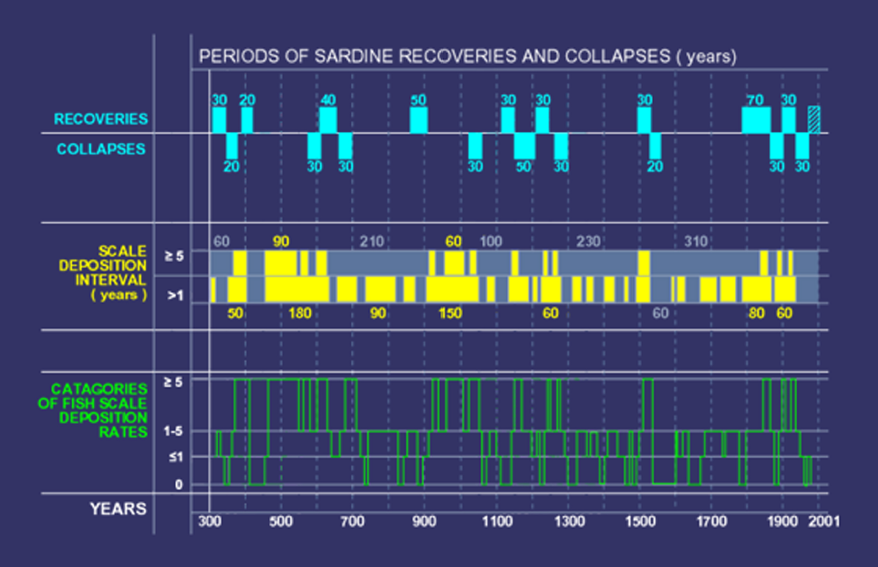
(Click on Image for larger Version)
It’s important to note that most of sardine collapses in this timeframe occurred when there was virtually no commercial fishing. The best science now attributes great fluctuations and collapses experienced by sardines to be part of a natural cycle.“Pinsky has never been a terrestrial biologist or naturalist or he would have known that small rodents have boom and bust cycles brought about by combinations of environmental conditions and the mice's early maturity and high fecundity rates, ” says Dr. Richard Parrish, an expert in population dynamics now retired from the National Marine Fisheries Service, .“All fish stocks show boom and bust cycles in recruitment unrelated to fishing, ” says Dr. Ray Hilborn, internationally respected fisheries scientist from the University of Washington. “Sardines in particular have been shown to have very great fluctuations and collapses long before commercial fishing. Fast growing, short-lived species will be much more likely to decline to a level called "collapse" when recruitment fluctuates because they are short lived -- longer lived species won't decline as much. ”As a further poke in the eye to the truth, Pinsky cites sardines off the coast of Southern California as a species that has seen fluctuations for thousands of years, but “not at the levels that they’ve experienced in recent decades due to overfishing. ”Again, this simply is not true.Since the fishery reopened in 1987, Pacific sardines have been perhaps the best-managed fishery in the world – the poster fish for effective ecosystem-based management. The current harvest control rule, updated to be even more precautionary in 2014, sets a strict harvest guideline that considers ocean conditions and automatically reduces the catch limit as the biomass declines.If the temperature is cold – which scientists believe hampers sardine recruitment – the harvest is reduced. And if the population size declines, both the harvest rate and the allowable catch will automatically decrease, and directed fishing will be stopped entirely when biomass declines below 150,000 mt.In fact, the current sardine harvest rule is actually more precautionary than the original rule it replaced. It does this by producing an average long-term population size at 75 percent of the unfished size, leaving even more fish in the water, vs. 67 percent in the original rule. The original harvest rule reduced the minimum harvest rate to 5 percent during cold periods. The present has a minimum rate of 0 percent during cold periods.Compare this to the 1940s and '50s when the fishery harvest averaged 43 percent or more of the standing sardine stock with little regulatory oversight and no limit on the annual catch. This, coupled with unfavorable ocean conditions, culminated in the historic sardine fishery collapse that devastated Monterey's Cannery Row.But that was nearly 70 years ago, not “recent decades. ” Our current fishery harvest is less than a quarter of the rate observed during that historical sardine collapse.As a scientist, Pinsky should be aware of the complex, proactive management efforts that have been in place for decades to prevent overfishing in California and the west coast. He should also be aware of the data from Baumgartner that contradicts his faulty conclusions.D. B. Pleschner is executive director of the California Wetfish Producers Association, a nonprofit dedicated to research and to promote sustainable Wetfish resources.
Copyright © 2015 Seafoodnews.com
Global Fisheries Scientists set up 'Truth Squad' to Counter Inaccurate Scientific Claims in Media
— Posted with permission of SEAFOODNEWS.COM. Please do not republish without their permission. —
Copyright © 2015 Seafoodnews.com

Their media partners lap up stories of doom and collapse, often uncritically. For that reason, a group of International experts in fisheries management have come together as part of a new initiative, called CFOOD (Collaborative for Food from Our Oceans Data.) The coalition will gather data from around the world and maintain fisheries databases while ensuring seafood sustainability discussions in the media reflect ground-truth science.The scientists behind the project have long pushed for accurate and clean data sources on the world's fisheries.The CFOOD project, headquartered at the University of Washington’s School of Aquatic and Fishery Sciences (SAFS), is made up of a network of scientists whose mission stemmed from a frustration with erroneous and agenda-driven stories about fisheries sustainability in the media. The CFOOD project will maintain a website and social media channels that provide a forum for immediate feedback on new seafood sustainability reports and studies.“The CFOOD website allows us to offer independent scientific commentary to debunk false claims, support responsible science, or introduce new issues based on recent research,” said Dr. Ray Hilborn, Professor at University of Washington’s SAFS and founder of the CFOOD initiative.“The ocean is a remarkably abundant source of healthy protein,” said Hilborn. “And while sustainability challenges exist, particularly in areas lacking sufficient fishery management infrastructure, many fisheries around the world are well-managed and sustainable. The message doesn’t always seem to resonate with consumers because of misinformation they continue to hear in the media.”By reviewing and providing scientific analysis on relevant studies, papers, and media reports the CFOOD network hopes to use science to set the record straight for consumers, so they can have confidence the seafood they purchase is harvested in an environmentally responsible fashion.Other scientists on the editorial board for CFOOD include Robert Arlinghaus, Leibniz-Institute of Freshwater Ecology and Inland Fisheries and Humboldt at Universität zu Berlin; Kevern Cochrane, FAO Retired, Cape Town, South Africa; Stephen Hall, World Fish Center, Penang, Malaysia; Olaf Jensen, Rutgers University; Michel Kaiser, Bangor University, UK; Ana Parma, CONICET Puerto Madryn, Argentina; Tony Smith, Hobart, Australia; Nobuyuki Yagi, Tokyo University.“Exaggerated claims of impending ecological disaster might grab attention, but they risk distorting effort and resources away from more critical issues. I hope this initiative will help provide the balance we need,” said Dr. Stephen Hall, Director General, World Fish Center, based in Malaysia.The first set of comments on the CFOOD website debunks a WWF paper claiming a 74% decline in global mackerel and tuna species. The scientists point out that the data used to support that conclusion is out of date, having not been updated since 2004, and that more robust data sources, such as the actual stock assessments of tuna and mackerel stocks around the world were not used by the WWF in creating their estimate. We explore the comments in depth in our related story.To connect with the scientists, you can use twitter, facebook, or their website.Website: Twitter: Facebook:
John Sackton, Editor and PublisherCopyright © 2015 Seafoodnews.com
Will El Niño ‘solve’ drought? Not if the rain falls in Southern California
We’re much better off if it rains in the north than in the south.
Peter Gleick, Pacific Institute
In all, California has 43 million acre-feet of reservoir storage space, almost three-quarters of it north of Fresno. The largest of these reservoirs, Shasta, Oroville and Trinity in far Northern California, account for almost a quarter of the state’s surface water supplies.Jay Lund is a civil and environmental engineering professor at UC Davis and heads the university’s Center for Watershed Sciences. During a recent interview, Lund held up a chart that showed a seemingly random scattering of points on a graph. The dots represented Sacramento River runoff during El Niño years, he said, underscoring the uncertainty of whether this year’s El Niño will substantially raise water levels in the northern reservoirs.“It looks like a shotgun blast,” he said. “You wouldn’t want to bet on this. Maybe we will get a lot of water. Maybe we won’t.”El Niño conditions occur when ocean temperatures warm along a stretch of the equatorial Pacific roughly twice the size of the United States. The warming leads to a shift in weather patterns that typically cause West Coast storm systems to move south.During weak or moderate El Niño events, in which Pacific water temperatures rise by a modest amount, it’s hard to find a consistent rain pattern in Sacramento, according to a Sacramento Bee review of data back to 1950. The average precipitation in those years was 18 inches – about normal for the city. Stronger El Niño years – when ocean temperatures rise by a significant amount as they have this year – are more encouraging. During those years, rainfall in Sacramento averaged 24 inches, roughly 130 percent of normal.If that happens, and El Niño douses central California as far north as Sacramento, it would substantially ease the burden on the state’s water supply – even if the storms don’t dump deep snow in the northern mountains, said Maury Roos, an hydrologist with the state Department of Water Resources.Roos said there are a number of smaller reservoirs south of Sacramento that help supply the state’s Central Valley farm belt. Crop irrigation, most of it in the Valley, accounts for about 80 percent of the “developed” water in California, meaning water that people put to use.

“If it gets as far north as where we are, then it will help a lot more,” said Roos from his office in Sacramento. “Then you can help to refill some of the major reservoirs around the rim of the Valley.”If the bulk of the heaviest rains stay further south, a wetter Southern California will help, but not nearly as much.“We’re just not set up to handle the capacity, the total volume of water that we’re really dealing with,” said Garrison, the UCLA geologist. “A 1-inch rainstorm in L.A. can produce 10 billion gallons of runoff ... most of which ultimately will end up flowing down the L.A. River and out to the ocean. We don’t have capacity to capture large events like that and really put them to use yet.”Still, the situation has improved since the state’s last deep drought in the early 1990s. Several major Southern California cities and irrigation districts have made strides in recent years to capture more stormwater, reduce local use and make imported reserves last longer.Rich Atwater, executive director of the Southern California Water Committee, said the region, on average, now gets about 12 percent of its water supply from locally captured stormwater. Southern California is investing in infrastructure improvements that should increase this capacity 5 percent, he said.The region also gets about 10 percent of its water from recycled sewage, he said. He expects that figure to double in the next 25 years. That’s based, in part, on an ambitious plan for what would easily be the largest wastewater recycling effort in the state. The Metropolitan Water District of Southern California is discussing a project that would produce 168,000 acre-feet of potable water using treated sewage to replenish groundwater supplies.The water district, which serves 19 million customers, recently spent close to $3 billion on a reservoir and tunnel project at Diamond Valley Lake near Hemet in Riverside County. The reservoir can capture 800,000 acre-feet – or about 260 billion gallons – of water. But for now, there’s no ready infrastructure for funneling in storm runoff from around the region. The reservoir will capture rain that falls directly in its walls, but it is only plumbed to receive water piped from Northern California.
A 1-inch rainstorm in L.A. can produce 10 billion gallons of runoff ... most of which ultimately will end up flowing down the L.A. River and out to the ocean. We don’t have capacity to capture large events like that and really put them to use yet.
Noah Garrison, UCLA Institute of the Environment and Sustainability
The biggest benefit to Southern California from El Niño storms could be replenishment of groundwater supplies. In the drought, government surface deliveries have been slashed to a fraction of what they have been in average rainfall years. Central and Southern California cities and farms have been furiously pumping groundwater to make up for the loss.Over the decades, several Southern California water districts have invested in groundwater banks and groundwater recharging projects to offset the unreliability of imports from the north and the Colorado River. These projects make use of imported water or natural flows that are channeled into swampy or porous areas where the water can seep into the ground for later pumping.Kern County has created the state’s largest water bank, primarily to help irrigate its $7.5 billion agricultural industry. The storage network, spread across numerous irrigation districts, can hold 5.7 million acre-feet of water.In the drought, even this massive system has been depleted. Jon Parker, general manager of the Kern Water Bank Authority, said his district alone can store up to 1.5 million acre-feet. In the drought, pumping has lowered that level to 500,000 acre-feet.Robb Whitaker, general manager of the Water Replenishment District of Southern California, said drought-related pumping has similarly drained the groundwater stored under his district, which supplies about 40 percent of the water for 4 million people in southern Los Angeles County. He said a single wet El Niño year could put more than 150,000 acre-feet of water back into the ground.“The basins are very, very dry. ... They’re ready to capture water,” Whitaker said. “It’s like a dry sponge, and we’re hopeful we’d be able to get about twice the normal capture, if not more. In that case, we could be caught up in two or three wet seasons.”The challenge with water banks and groundwater recharging is that too much rain too fast can overwhelm the system. Unlike a traditional reservoir, the basins that capture groundwater need time for that water to seep in.“If the engineers and the water managers could control all the knobs like the great and powerful wizard of Oz, they would like it to come down at a moderate pace for a long time, so the system could sort of absorb it as it happens,” said Kelly Redmond, deputy director and regional climatologist for the federal government’s Western Regional Climate Center in Reno.“If you overwhelm the system, some of it will go into groundwater recharge, but a lot of it will just go out to the ocean, and I guess your perspective on whether that’s wasted water or not might depend on if you’re a water manager or a fish.”At the most basic level, a prolonged soaking would keep Southern California residential landscapes green longer without sprinklers. Some residents are hoping to extend that run with rain barrels, which while not widespread, have gained some traction through rebate programs.Geri Cicero, a retired administrative assistant from Costa Mesa, is ahead of the curve on that front. She said that even before the drought, she installed rain barrels and other water-catching devices around her property. She’s anxious for an El Niño to fill them up for later landscape use.“If you walked around my house, you’d see bucket after bucket and barrel after barrel,” she said. “It’s almost like a game for me. I really enjoy it.”Atwater, with the Southern California Water Committee, has rain barrels, too. While they’re helpful in getting people to think about how much water they use on their landscape, he said, they can only do so much in solving the state’s water storage needs. He said he uses larger rain barrels than most people, and they’re empty within a week or two after a storm.“A 50-gallon rain barrel doesn’t go very far,” he said.
| Reservoir | Size (acre-feet) | Pct. full | Pct. of normal |
| Shasta Lake | 4,552,000 | 35% | 58% |
| Lake Oroville | 3,537,577 | 30 | 49 |
| Trinity Lake | 2,447,650 | 22 | 32 |
| New Melones Lake | 2,400,000 | 11 | 20 |
| San Luis Reservoir | 2,041,000 | 19 | 40 |
| Don Pedro Reservoir | 2,030,000 | 31 | 47 |
| Lake Berryessa | 1,602,000 | 52 | 70 |
| Lake Almanor | 1,308,000 | 55 | 96 |
| Lake McClure | 1,024,600 | 8 | 19 |
| Pine Flat | 1,000,000 | 12 | 35 |
| Folsom Lake | 977,000 | 18 | 31 |
Read the original post: http://www.sacbee.com/
Dolphins, Pelagic Red Crab, Sun Fish Point to El Nino Coming to Northern California
The subjects of science are often witnessed through microscopes, tiny squiggly things writhing in a petri dish. But last week as a large research boat drifted through the Gulf of Farallones National Marine Sanctuary, science was getting scrutinized through binoculars and even the naked eye.
For the 12th year in a row, researchers from Point Blue Conservation Science, the Gulf of Farallones and Cordell Bank Marine Sanctuaries were spending 10 days on the ocean outside the Golden Gate Bridge taking a scientific snapshot of ocean life.
“Our goal is to understand how ocean conditions affect food for birds and whales,” said Jaime Jahncke of Point Blue.
Over several days the team collected krill samples, tested for signs of ocean acidification and attempted to lay eyes on as many critters as possible.
“Our sampling effort looks at birds, mammals, krills, boat activity ,” said Jan Roletto, research coordinator for Gulf of Farallones National Marine Sanctuary.
But this year’s gathering turned-up some unusual phenomenon, which scientists believe are signs of an El Nino year - which draws unusually warm waters to Northern California. For the first time in decades, scientists saw schools of hundreds of common dolphins which aren’t common to the Bay Area, but rather the typically warm waters of Southern California.
“It’s a sign the water is more warm than we normally see,” Roletto said. “And that’s a sign of El Nino."
Scientists have recorded large pockets of warm water along the West Coast over the last two years - which they’ve affectionally nicknamed “the blob.”
“This year has been particularly interesting,” Jahncke said. “The ocean has been really warm because of 'the blob.' ”
During an expedition earlier this summer, the scientists noted fewer krill in the ocean which in turn was driving humpback whales closer to shore near Half Moon Bay and Monterey to seek out fish.
“There are more whales visible from the mainland,” Roletto said. “That’s because that’s where the fish are being concentrated.”

In addition to dolphins, Roletto said the group spotted other typically warm water creatures venturing north. Sleepy-looking sun fish were seen basking in the waters. And the researchers’ nets pulled up a curious traveler — a small red pelagic crab that normally makes its home near Baja.
“The last time I personally saw in this region red pelagic crabs was in the 1983, 1984 El Nino,” Roletto said.
Roletto said the lack of krill and juvenile rockfish which are normally abundant along the coast was posing hardships on common murres which have been recently turning-up starving and dead on Northern California beaches. Roletto said the young birds count on juvenile rockfish to survive. She pointed out similar die-offs occurred in past El Nino years.
“That’s pretty extreme,” Roletto said, “pretty significant indicator that something is missing in the eco system.”
As part of the research, observers armed with binoculars lined the boat’s upper deck, calling out every bird and mammal along a set swath of ocean near the Farallon Islands. Sea lions, whales and even plain old seagulls became part of a moving record of the area’s life. The results are compared to previous years’ records to help paint a picture of the changing conditions.

“It’s really interesting because things change from day to day,” said Danielle Lipski of Cordell Bank Marine Sanctuary. “Sometimes we’ll see lots of whales and seabirds and in other areas we won’t.”
Jahncke stared off across the churning waters as the boat bobbed and jibed across rolling swells — when something suddenly caught his eye. In the distance came the telltale blowhole spout of a whale.
“Do you see it?” he said enthusiastically, quickly tapping record of the sighting into his computer. Then he leaned back to appreciate the view, watching as the ocean swallowed the meandering giant.
View the original post: http://www.nbcbayarea.com/
NEW SUSTAINABLE SEAFOOD REPORTING APPLICATION AVAILABLE FOR BUSINESSES

September 28, 2015 — FORT COLLINS, Colorado — The following was released by FishChoice:
New Sustainable Seafood Reporting Application Available for Businesses
Online Application Enables Businesses to Self-Assess the Sustainability of their Seafood
Powered by FishChoice.com, in partnership with the Monterey Bay Aquarium Seafood Watch® program and Seattle Fish Co., the new Sustainable Seafood Calculator application enables businesses to self-assess and track the sustainability of their seafood.
“We partnered with FishChoice.com to create the Seafood Calculator to allow our customers to easily and accurately rate the sustainability of their seafood,” says Derek Figueroa, COO of Seattle Fish Co. “The Seafood Calculator is a valuable and straightforward tool that makes it easy for Seattle Fish Co. to deliver up-to-date information to our customers and allow them to drive real change.”
Chefs, retailers, distributors, and others register for a free account and can immediately start creating one or more lists of their seafood inventory. At any time, users can calculate sustainability where they will be directed to a dashboard with a table of their seafood inventory matched with corresponding up-to-date sustainability information. The dashboard also includes a collection of charts summarizing their seafood categories by overall sustainability and by individual sustainability categories. Additionally, users of the application receive email notifications when there are updates to the sustainability of any of their items.
Currently, over 500 companies have tested the application and use it to track and report the sustainability of their seafood. Chefs are some of the main businesses benefiting from the application. According to Sheila Lucero, Executive Chef, Jax Fish House and Oyster Bar, “We are committed to our sustainability practices and being able to utilize the Seafood Calculator has been a beneficial tool to our chefs.” The sustainable seafood calculator can be found at http://www.fishchoice.com/sustainableseafoodcalculator/.
Read the original post www.savingseafood.org/
‘The Blob’ Fueling Drastic Changes Under The Sea Ahead Of El Niño
It’s the crack of dawn on a recent morning at Fisherman’s Landing in Point Loma, and the docks are bustling.Dozens of enthusiastic anglers have just returned with a boatload of bluefin tuna, dorado and yellowtail.It’s been a banner season, said Andrew Dalo, who books reservations for Point Loma Sportfishing.“I’ve got overnight and day-and-a-half boats that are catching 100- to almost 200-pound bluefin tuna up off our coast here, out west and up north," Dalo said. "And that’s stuff that we don’t even normally see up here, let alone go after."

Point Loma Sportfishing - A group of anglers on a Point Loma Sportfishing expedition pose with their bluefin tuna catches, weighing 100 to 200 pounds each, July 29, 2015.
The tropical fish are typically reeled in off Mexico and far off-shore, Dalo said. Now they’re being hooked as close as 10-20 miles off of San Diego, where water temperatures are exceptionally warm.“Right now we’re 4 to 5 degrees above normal, which to you and me doesn’t seem like much, but if you’re an animal living in the sea and you live at that temperature — that’s a huge change,” said Toby Garfield, director of the Environmental Research Division at Southwest Fisheries Science Center in La Jolla.The warm water, which scientists have named “the blob,” formed two years ago near Alaska and has spread down the West Coast. Garfield said the warm conditions have sent mother nature into disarray.“In fact, having this additional warm water has changed the winds a little bit,” Garfield explained. “The upwelling winds really drive the productivity along the California coast. So if you reduce that productivity, you start changing a lot of different parts of the whole ecosystem.”Much of the fishery population has shifted north, and El Niño hasn’t even arrived yet, said Garfield, who analyzes ocean conditions and reports his findings to the Pacific Fishery Management Council."If you go out and do an assessment and you’re not sure where that population is from, you can get some erroneous results in terms of how you’re going to divide up the fisheries," Garfield said. "And remember, the fish don’t know there’s a Mexican border or Canadian border."“We really do have a front row seat on a fascinating change,” Garfield added. “We haven’t seen it this anomalously warm in the record, and at the same time, we’re having a developing El Niño.”Garfield said he sees two possible scenarios playing out this winter: El Niño's storm energy will stir up the water, causing the cool water from the ocean depths to mix with and cool the water at the surface.“That’s one scenario — that it may disappear and will go back to more normal temperatures,” Garfield explained. “The other scenario is that the two will reinforce each other and we’ll have even warmer conditions, and the weather patterns will be different than we expect with a normal El Niño.”Garfield says additional heat from El Niño could produce storms with higher energy and moisture.Meanwhile, the telltale signs of current ocean water temperatures from “the blob” have appeared in recent months along San Diego’s shores. The unusual visitors range from hammerhead sharks to tropical fish to millions of red tuna crabs.“We’ve also seen 'by the wind sailors' that have occurred en masse on the shores here on La Jolla and elsewhere,” said David Checkley, a professor of marine biology at Scripps Institution of Oceanography.Checkley said the reduction in upwelling of cold water nutrients from the ocean floor has drastically altered the food web.“At the base of the food chain it’s been observed that the amount of chlorophyll or phytoplankton is lower than normal because we have fewer nutrients brought up into the surface waters,” Checkley said.Phytoplankton provide food for a wide range of sea creatures including whales, shrimp, snails, and jellyfish, according to the National Oceanic Atmospheric Administration.“The continued poor health of the California sea lion population is likely due to a lack of forage — anchovy, sardines... perhaps squid,” Checkley said.An algal bloom occurring along the West Coast from California up to Alaska is also a growing concern.“Those harmful algal blooms sometimes come with toxins — demoic acid that can poison marine mammals that eat fish that consume those algae," he said.Checkley said water temperatures will likely eventually return to normal, but he can’t help but look at the conditions as a harbinger of the future.“What perhaps is worrisome is if you think of things such as this and a long-term trend in a rise in temperatures associated with the climate warming or climate change,” Checkley said.He predicts some sea creatures will suffer through El Niño.“The winners are the recreational fishermen,” Checkley said.San Diego's sportfishing season usually wraps up in September, but not this year.
“We’re hoping this stuff stays around,” Dalo said. “If it stays up here, we can fish in U.S. waters. You bet. We’ll fish into October. We’ll fish into November.”


NASA - This map of the West Coast shows sea surface temperature anomalies in the Pacific Ocean in March 2015. They show how much above (red) or below (blue) water temperatures were compared to the long-term average from 2003 to 2012.
 By Susan Murphy - Tuna crabs blanket the shoreline at Ocean Beach in San Diego, June 12, 2015.
Read the original post and watch the video: www.kpbs.org
Monterey Bay fishermen secure $1M in fishing rights
 The bright afternoon sun beats down on a fisherman as he casts his line off the Santa Cruz Municipal Wharf on Tuesday. (Kevin Johnson -- Santa Cruz Sentinel)
MONTEREY >> A big benefit for the local community, Monterey Bay anglers now will have permanent access to more than $1 million in commercial groundfish fishing quota thanks to a recent acquisition by the Monterey Bay Fish Trust.“Oftentimes, it is extremely difficult to get quota,” said Giuseppe Pennisi, a local commercial fisherman. “Having access to quota is the only way that we can fish consistently.”West Coast groundfish numbers have struggled for years, and so have the livelihoods of many fishermen with it. More than a decade after the federal government declared the groundfish fishery a disaster, new regulations rolled out to help the fish and fishermen rebound.Since 2011, the fishery has been subject to a “catch share” system. Now fisherman no longer have to race against one another, trying to catch as many fish as possible before the entire fishery’s quota is reached. Instead, they’re allotted a share of the quota and can fish at their own speed.The program, which is highly regulated and includes a bycatch quota as well, has been successful in terms of conservation. In 2014, the Monterey Bay Aquarium’s Seafood Watch program upgraded 21 groundfish species from the “avoid” list to “good alterative” or “best choice.”But a concern of the “catch share” system is that fisherman can sell their quota allocations on the open market to the highest bidder. It leaves smaller fishing communities like the Monterey Bay in jeopardy of losing out to bigger markets and businesses in the Pacific Northwest that have more money to buy the quota shares.“The big fish companies hoard their fishing quotas, which then become unavailable to independent fishermen,” Pennisi said.To protect local fishing businesses, the Monterey Bay Fisheries Trust was created to manage and lease groundfish quota to fishermen here, while working to improve the economic and environmental aspects of the fishery.The nonprofit secured the $1 million in fishing rights from the Nature Conservancy, which purchased quota shares from willing sellers to lease them back to local fisherman who operate more sustainably before the “catch share” system — and a cap on the amount of shares any individual or entity can hold — was implemented. So the Nature Conservancy has been divesting shares to local community organizations focused on conservation as well.“Now local fishermen will know that they have access to this supply of quota, they don’t have to compete for it on the open market and they don’t have to compete with bigger businesses,” said Sherry Flumerfelt, executive director of Monterey Bay Fisheries Trust.The acquisition equates to about 4.2 million pounds of different groundfish species, including sable fish, rockfish and petrale sole. Though the amount is a major boost for Monterey Bay fishing industry, commercial fishers still can’t afford all the quota shares they need.“It sounds like an awful lot and it’s a good start, but it’s not enough,” Flumerfelt said. “We’re looking to buy more.”Last month, the Monterey City Council allocated $225,000 to purchase additional groundfish quota.Monterey Bay fishermen need an estimated 6 million to 10 million pounds worth of quota to maintain a sustainable economy. However, it’s a tricky number to pin down because some species of groundfish are worth more than others.
Read the original post: www.santacruzsentinel.com/
Zeke Grader, Lifetime Advocate for Fish and Fishermen, Died at 68
 Zeke Grader, who was born into the fishing industry, spent a lifetime representing fishermen and was a staunch advocate for sustainable seafood, died Monday of pancreatic cancer at a San Francisco hospice. The longtime Sausalito resident was 68.For almost 40 years, Mr. Grader served as executive director of the Pacific Coast Federation of Fishermen’s Associations, the largest trade group of commercial fishermen on the West Coast. He retired this summer. Since 1992, he had also been executive director of the Institute for Fisheries Resources.“There are a lot of guys who would say that there wouldn’t have been any small boat commercial salmon fishermen for 20 years at least if not for Zeke Grader,” said Tim Sloane, who took over Grader’s post as head of the Federation of Fishermen’s Associations. “He built bridges between fishermen, policy folks, environmentalists and the scientific community. His ability to unite people around preserving the fisheries was unmatched.”The son of a Fort Bragg fish broker, Mr. Grader was an early advocate of seafood sustainability, and was particularly passionate about protecting wild salmon.“I think it was not so much a conscious decision of wanting to be a conservationist or an environmentalist; it was simply an economic necessity,” he once said in an interview with the Seafood Choices Alliance. “It was pretty clear to myself and a number of others that it didn’t matter what government or others did. If you didn’t have fish, you didn’t have fishing.”At a tribute to Mr. Grader at the Bay Model in Sausalito in April, Rep. Jared Huffman recalled Mr. Grader’s 2009 appearance on Sean Hannity’s conservative Fox News show. Hannity argued on behalf of government-subsidized fish farmers while Mr. Grader spoke forcefully for North Coast commercial fishermen.“Sean Hannity barely got a word in,” Huffman told the amused gathering.The congressman also commended Mr. Grader for helping stop the expansion of offshore oil drilling on the North Coast and for his role in the legal action to restore the San Joaquin River.Former congressman and secretary of state Leon Panetta spoke in a video tribute. In his blog, Lee Crockett of the Pew Charitable Trust quoted Panetta as saying, “If our oceans are the salt in our veins, Zeke Grader is the fire in our spirit.”Environmental journalist Dan Bacher wrote in the liberal political blog the Daily Kos that Mr. Grader “was one of the most quotable and witty people I’ve ever met.” He recalled his trenchant response to a 2006 federal government attempt to close the North Coast salmon season, ostensibly to protect the Klamath River.Bacher wrote:“Zeke pointed out that without efforts to address the root causes of the salmon fishery’s decline, ‘Putting fish back into a river that’s killing them makes as much sense as tossing virgins into a volcano.”Mr. Grader’s wife of 40 years, Sausalito attorney Lois Prentice, said that her husband was tireless in his efforts to protect the world’s oceans and rivers. Before he became ill, she said, “He was working on forming a worldwide organization for fisheries, to fight for clean water and against pollution. As a result, it would have a lot of clout and get a lot more done.”A Marine Corps veteran, Mr. Grader was a graduate of Sonoma State University and earned a law degree from the University of San Francisco.In addition to his wife, he is survived by his mother, Geraldine Grader of Fort Bragg, sisters Allison Grader of Reston, Virginia, and Lindsay Grader of Sacramento, and a brother, Samuel Grader of Fort Bragg.A memorial is being planned.